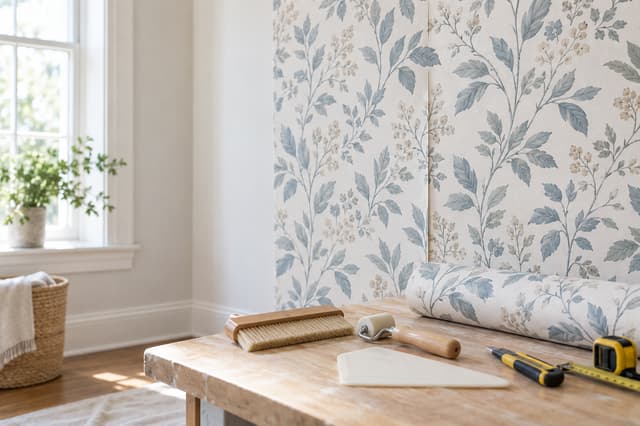
Read before you buy
A deeper planning guide
Use these notes to check the assumptions behind the estimate and decide what to verify at the store or on site.
Measure Walls and Openings
Measure every wall in the room, including the height from the finished floor to the ceiling. The calculator models two pairs of equal walls, so an irregular room should be divided into wall runs and checked separately. Record doors and windows by their actual width and height, but remember that an opening does not always remove a complete wallpaper strip from the order.
Use a sketch to mark corners, outlets, sloped sections, and the wall where the pattern should begin. The first strip and the final strip often create more offcut than a simple area deduction suggests. A measured plan makes it easier to decide whether the basic estimate is adequate or a professional roll layout is needed.
Understand Roll Dimensions
Read the physical roll width and total length from the package instead of relying on the words single roll or double roll. Retail terminology varies by region and brand. Enter the actual dimensions and the price for one purchasable roll so the calculator can estimate strips per roll and whole rolls consistently.
The usable width is treated as the printed width. Trimming, selvage, and installation instructions can reduce it. If the label gives a coverage figure that already accounts for these losses, use the manufacturer's figure for a manual comparison and do not combine it with a second hidden deduction.
Pattern Repeat and Usable Drops
A vertical pattern repeat means a full-height drop must be cut at a compatible point in the design. The calculator rounds the wall height up to the next repeat before finding how many drops fit in a roll. Enter zero for a plain or random-match design. For a half-drop or complex match, the repeat value is only a planning approximation because the starting offset changes from strip to strip.
The area deduction for doors and windows is useful for a first estimate, but it cannot promise that every offcut is reusable. Place major openings on the sketch, choose a pattern starting point, and verify the number of full drops with the manufacturer's calculator when the design is expensive or difficult to match.
Worked Roll Estimate
Suppose a room has 44 linear feet of wall, an 8 foot height, 20.5 inch roll width, 33 feet of roll length, a 20.5 inch pattern repeat, and 10 percent waste. The adjusted drop is 8.2 feet, so three drops fit in a roll. If the net area and allowance require 29 full-height strips, the purchase is round up(29 ÷ 3), or 10 rolls.
The arithmetic is intentionally conservative about pattern alignment. Before paying, confirm the package length, pattern repeat, batch code, and return policy. Buy all rolls together when possible so color and print variation do not appear on the finished wall.
Where the Estimate Can Fall Short
This calculator does not create a cut list for stair walls, vaulted ceilings, murals, chair rails, or rooms with several different heights. It excludes adhesive, sizing, primer, tools, labor, delivery, and tax. It also assumes a rectangular strip can be handled as a full-height drop, which may not fit a short roll, a long repeat, or a heavily damaged surface.
Use the result for budgeting and a first purchase conversation. Follow the wallpaper manufacturer's instructions for substrate preparation, paste, booking, seam placement, moisture, and batch matching. If a small shortage would stop the project, round toward an extra roll and confirm that unopened rolls can be returned.